#Chaitanya
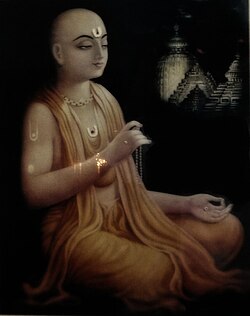
Sri Chaitanya Mahaprabhu (1486-1533)
Krishna’s avatars descend to protect the principles of religion and destroy the miscreants. When Krishna descended at the end of Dvapara-yuga and even earlier, He physically destroyed demons and taught people devotion to Him. However, people did not understand Krishna. Some considered Him a king, others a prophet, still others an impostor, and only a very few sages understood His true position and could fully surrender to Krishna. Many moralists criticized Krishna for killing demons so intensively. Even in these times, religious moralists criticize Krishna. Therefore, this time the Lord descended differently. Now His weapons are not a disc and a club, but His devoted associates. Now He does not kill demons, but destroys the demonic mentality of atheists and mayavadis. Previous avatars destroyed demons physically to relieve the burden of the Earth. This time, the Lord did not destroy demons physically but made them devoted servants of the Lord. Together with Nityananda Prabhu, He distributed love of God even to those who did not want or seek it. And even more, in choosing their “victims”, they first looked not at those who were most worthy of mercy, but at those who needed it most, that is, the most fallen. He is the son of Sachi devi, therefore His name is Sachinandana. Mahaprabhu means the great master.
Visvanatha Chakravarti Thakura summarized Lord Chaitanya’s teachings in this verse:
-
ārādhyo bhagavān vrajeśa-tanayas tad-dhāma vṛndāvanaṁ
ramya kācid upāsana vraja-vadhū-vargeṇā va kalpitā
śrīmad bhāgavataṁ pramāṇam amalaṁ premā pum-artho mahān
śrī-caitanya mahāprabhor matam idaṁ tatrādarāḥ na paraḥ
“The Supreme Personality of Godhead, the son of Nanda Maharaja, is to be worshipped along with His transcendental abode, Vrindavan. The most pleasing form of worship to the Lord is that which was performed by the gopis of Vrindavan. Srimad-Bhagavatam is the spotless authority on all matters, and pure love of God is the ultimate goal of life for all humans. These statements, for which we feel the highest respect, are the opinion of Sri Chaitanya Mahaprabhu.”
Bhaktivinoda Thakura further divided Lord Chaitanya’s teachings into ten basic truths, which are called “Dasa mula tattva”:
-
āmnāyaḥ prāha tattvaṁ harim iha paramaṁ sarva-śaktiṁ rasābdhiṁ
tad-bhinnāṁśāṁś ca jīvān prakṛti-kavalitāṁs tad-vimuktāṁs ca bhāvāt
bhedābheda-prakāśaṁ sakalam api hareḥ sādhanaṁ śuddha-bhaktiṁ
sādhyāṁ tat-prītim evety upadiśati harir gauracandro bhaje tam
“I worship the Lord Hari, Gaurachandra, who teaches us these ten theistic principles…”
Lord Chaitanya Mahaprabhu did not write any books. Only a single work is attributed to his hand, “Sri Sikshashtaka”, in which, in eight verses, Sri Chaitanya very concisely summarizes the path from harinama sankirtana—the chanting of holy names—to pure devotional service, full of the highest relationship with God—madhurya rasa. The teachings of Lord Chaitanya are classified under Vedanta darshana—the Vedanta school of philosophy. All Vedanta schools differ from one another, interpreting the relationship between God, the world, and living beings differently. On one side, Shankara’s extreme monism (advaita) asserts that there is no difference between God and living beings; there is only God, and the individual existence of different beings is explained as a manifestation of illusion. On the opposite side is Madhva’s dualism (dvaita), asserting that God and living beings are eternally distinct and related only as a creator to his creation. Between these extremes, the schools of Ramanuja, Nimbarka, and Vishnusvami are like attempts to connect the two opposing poles of Shankara’s and Madhva’s teachings. However, when speaking of God, no human explanations can be perfect. They can only reveal certain aspects of theology but cannot explain God’s relationship with the world better than God Himself. Bhagavan Sri Chaitanya Mahaprabhu announced His teachings to the world, which resolve the contradictions of all philosophical schools because He stated how things truly are.
Lord Chaitanya preached the doctrine called acintya bheda abheda tattva—the doctrine of inconceivable simultaneous oneness and difference. It integrates all the statements of the philosophical Vedanta schools that, from Chaitanya Mahaprabhu’s perspective, were correct and important. Indeed, Sri Krishna Chaitanya Himself is the original teacher of all sampradayas, and personalities like Shankara and Ramanuja worship Him in their prayers. Now Krishna Himself, having descended as Sri Chaitanya Mahaprabhu, gave the world a new sampradaya (school), of which he himself is the direct acharya (founder). Jiva Gosvami quotes these words of Sri Chaitanya:
“From Madhva I will take two essential teachings: His complete refutation of the Mayavada philosophy and his service to the deity of Krishna, whom he accepts as the eternal spiritual personality. From Ramanuja I will take two teachings: the idea of devotional service uncontaminated by jnana and karma, and service to the devotees. From Vishnusvami’s teaching I will take two elements: the feeling of complete dependence on Krishna, and the path of raga marga or spontaneous devotion. From Nimbarka I will take two very important principles: the necessity of taking shelter of Srimati Radharani and the high appreciation of the gopis’ love for Krishna.”