#ISKCON
lith.: Tarptautinė Krišnos Sąmonės Bendrija - International Society for Krishna Consciousness.
The International Society for Krishna Consciousness (ISKCON), also known as the Hare Krishna movement, has five hundred centers, temples, and rural communities, nearly a hundred vegetarian restaurants, thousands of namahattas (local meeting groups), numerous community projects, and millions of congregation members worldwide. Although not much time has passed since 1966 when His Divine Grace A.C. Bhaktivedanta Swami Prabhupāda founded ISKCON, the movement has expanded greatly.
ISKCON belongs to the Gaudiya-Vaishnava sampradaya, a monotheistic tradition within Vedic or Hindu culture. Philosophically, it is based on the Sanskrit texts “Bhagavad-Gītā”, “Srimad-Bhagavatam”, and “Chaitanya-Charitamrita”. These are historical texts of the bhakti-yoga tradition, which teach that the ultimate goal of all living beings is to awaken love for God or Lord Krishna – “the all-attractive”.
God has countless names, such as Allah, Jehovah, Vishnu, etc. ISKCON members chant the names of God in the form of the maha-mantra, or the great prayer of liberation:
Hare Krishna, Hare Krishna, Krishna Krishna, Hare Hare
Hare Rama Hare Rama, Rama Rama, Hare Hare.Many prominent academics have noted the authenticity of ISKCON. Diana Eck, Professor of Comparative Religion and Indian Studies at Harvard University, describes the movement as “a tradition that occupies a respected place in the religious life of humankind.” In the 1970s, Dr. A.L. Basham, one of the world’s leading authorities on Indian history and culture, wrote about ISKCON: “In less than twenty years, it has appeared almost from nowhere and has become known throughout the West. I think this is a sign of the times and an important fact in the history of the Western world.”
The founder of ISKCON, Srila Prabhupada, received acclaim from scholars and religious leaders for his outstanding achievements in presenting India’s Vaishnava spiritual culture in a way that is relevant to a contemporary Western and global audience.
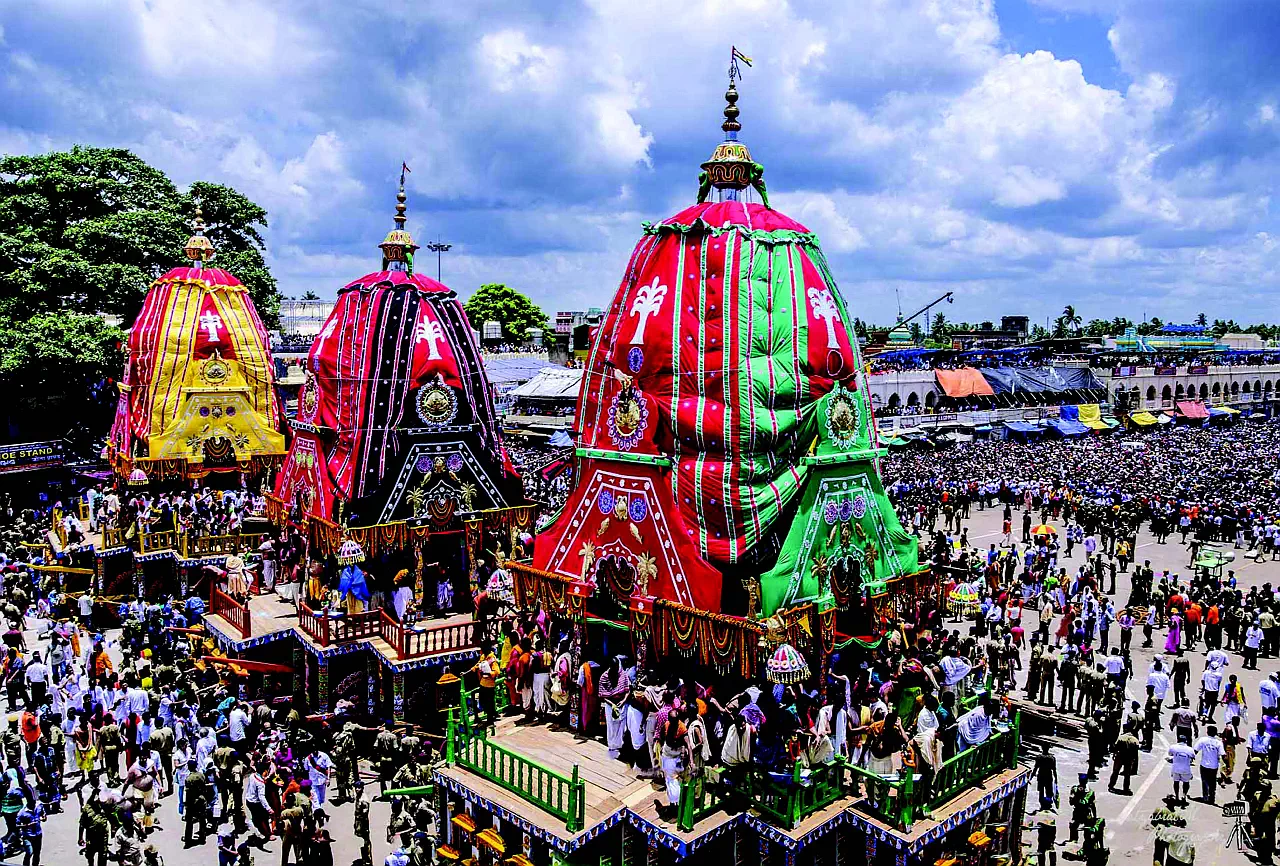
ISKCON members practice bhakti-yoga in their homes and worship God in temples. They also promote bhakti-yoga or Krishna consciousness in festivals, cultural events, yoga seminars, by chanting the mantra publicly and distributing Vedic literature. ISKCON members also establish hospitals, schools, colleges, eco-villages, free food distribution projects, and other institutions, practically applying the principles of bhakti-yoga.
The founder-acharya of the society formulated the following purposes of ISKCON:
    1. To systematically propagate spiritual knowledge to society at large and to educate all people in the techniques of spiritual life in order to check the imbalance of values in life and to achieve real unity and peace in the world;


    2. To propagate a consciousness of Krishna (God), as it is revealed in the Bhagavad-gita and Srimad-Bhagavatam;

    3. To bring the members of the Society together with one another and nearer to Krishna, the prime entity, thus developing the idea within the members, and humanity at large, that each soul is part and parcel of the quality of Godhead (Krishna);

    4. To propagate and encourage the sankirtana movement, congregational chanting of the holy name of God, as revealed in the teachings of Lord Sri Caitanya Mahaprabhu;


    5. To erect for the members and for society at large a holy place of transcendental pastimes dedicated to the personality of Krishna;

    6. To bring the members closer together for the purpose of teaching a simpler, more natural way of life;

    7. With a view to achieving the aforementioned purposes, to publish and distribute periodicals, magazines, books and other writings.